Greetings

This blog is a record of the wine that I make and drink. Each flavour made and each bottle drunk will appear here. You may come to the conclusion that, on the whole, I should be drinking less.
Showing posts with label making wine. Show all posts

Sunday, 3 October 2021

Gooseberry Wine 2021 - The Making Of...

For years we have been saying that our freezer is too small for all the excess fruit that I pick, and that we must investigate getting a small freezer just for wine making. Claire and I are great procrastinators. If you require further evidence, you only need to go into our front room. We have owned the house for six years now and have yet to paint the plaster.

Some of our gooseberries, close up.

Anyway, on Sunday 10th July I went on-line to investigate mini-freezers and about ten minutes later had ordered one. It arrived on Monday. Why I took about four years or so over this, I do not know. Mostly it will be filled with gooseberries this year. Our bushes are rampant. We have at least three varieties and all have had a good summer.

Gooseberries being washed

On Sunday 11th July I went out to harvest 6 lbs for this wine. Those in the back garden are not as far on as those in the front, but I still picked a few from each bush, getting lightly scratched in the process. Why are gooseberry plants quite so defensive of their fruit?

More gooseberries!

In the end, I picked 2 oz less than the 6 lbs required, but that was Good Enough. I put them in our largest cooking pot with 3 pints of water, brought them to the boil and let them simmer for 5 minutes. The whole lot went into my bucket with 2 lbs 14 oz sugar and a further two pints of cold water. I added a teaspoon each of yeast, nutrient, pectolase and tannin just before going to bed and by Monday morning it was all fermenting nicely

Gooseberry wine fermenting

The wine got one stir each day and I planned to put it in its demijohn on Friday evening. However, by then I had worked until 6:15 and was in a thoroughly bad mood, so I left it until this morning, 17th July.

Gooseberry does take a long time to put into its demijohn, though I had Radio 3's Record Review to keep me company. The wine is going to produce a huge sediment.

The first demijohn of Gooseberry Wine

It did - massive! I racked this on 20th August and I fit in most of 2 pints of water with 4 oz sugar dissolved.

I am making a second batch, this time crushing the berries rather than boiling them and 5 pints of boiling water. I started on Sunday 23rd August and racked it on 25th September. The sediment on this one was slightly smaller, but I put in 36 fluid ounces of water with 2 oz sugar dissolved.

Wednesday, 19 May 2021

Rhubarb Wine 2021 - The Making Of...

Sunday 9th May was a day for domestic tasks. Most Sundays are. Ever since I made a cake for Claire's birthday in January, and thereby discovering that I could, I have used Sunday mornings to make a cake or similar to keep us in treats throughout the week. This Sunday it was my Aunt Jennifer's Traveler's Biscuit Cake - neither cake nor biscuit but somewhere in between and the winning combination of delicious and easy.

Traveler's Biscuit Cake - neither cake nor biscuit

Most of the rest of Sunday was occupied by wine-making. I racked my orange and bottled both the crab apple and the crab apple & strawberry. But the day's main task was starting this year's rhubarb wine.

Rhubarb in the front garden

All rhubarb used this year is home-grown. Last year Claire relocated several rhubarb plants into our front garden, which gets the sun nearly all day. This year they are thriving and these were the plants that produced most the rhubarb for the wine. In comparison, our rhubarb in the back is a sickly cousin; limp and weedy.

Freshly picked rhubarb

With judicious picking of stalks, I got 3 lbs 12 oz. Whilst I could have got another 2 lbs 4 oz for a double batch, I decided to do a single instead. We have plenty of rhubarb wine dotted around the house and I should start decreasing our excess.

Rhubarb sticks being washed

I chopped 3 lbs of rhubarb stalks thinly (after washing them, of course) and put these in the bucket with 3 lbs sugar. I boiled up just over 6 pints of water and poured this in, stirring to dissolve the sugar. On Monday morning I added the yeast, pectolase and nutrient (a teaspoon of each) and I was moderately diligent at stirring once a day throughout the week.

Rhubarb chopped thinly

The wine went into its demijohn on Friday evening, 14th May, after a hugely busy day at work - by early afternoon I was on the honey & lemon to ease my throat. I had spent the day on call after call. Anyway, the wine making tasks were relatively quick and I now have a demijohn of pale pink liquid bubbling away.

The rhubarb in its demijohn


Saturday, 10 April 2021

Spiced Beetroot Wine 2021 - The Making Of...

I last made Spiced Beetroot Wine ten years ago. 2011 seems like a foreign country: they did things differently there. It is worth revisiting this flavour from time to time, not least because of its alarming colour. Also, on the whole my reds are better than my whites - and whilst this is not a traditional red (what with it being made from beetroot) it has the appeal of the unusual.

Not quite enough beetroot

I came home from Chapel Allerton on Saturday noon with not quite enough beetroot. Claire wanted two for her 'Beetroot, Goat's Cheese and Caraway' Bread, leaving me with 2½ lbs rather than the 3 lbs set out in my recipe. However, the bread was superb and I was deviating from my recipe in other ways, so this was no sacrifice at all.

Beetroot, Goats' Cheese and Caraway Bread

I began my wine-making on Easter Sunday, 4th April. Often at Easter we are in Newcastle or hosting Claire's siblings here but those options were impossible for obvious reasons. Instead I spent most the day in the kitchen baking (peanut butter cookies and lemon meringue pie, thank you for asking) and making wine to Classic FM's Top 300 Countdown. I chopped the beetroot into small-ish chunks and put these in my biggest pan with 6 pints of water. This was brought up to the boil and left simmering for 35 minutes.

Chopped Beetroot

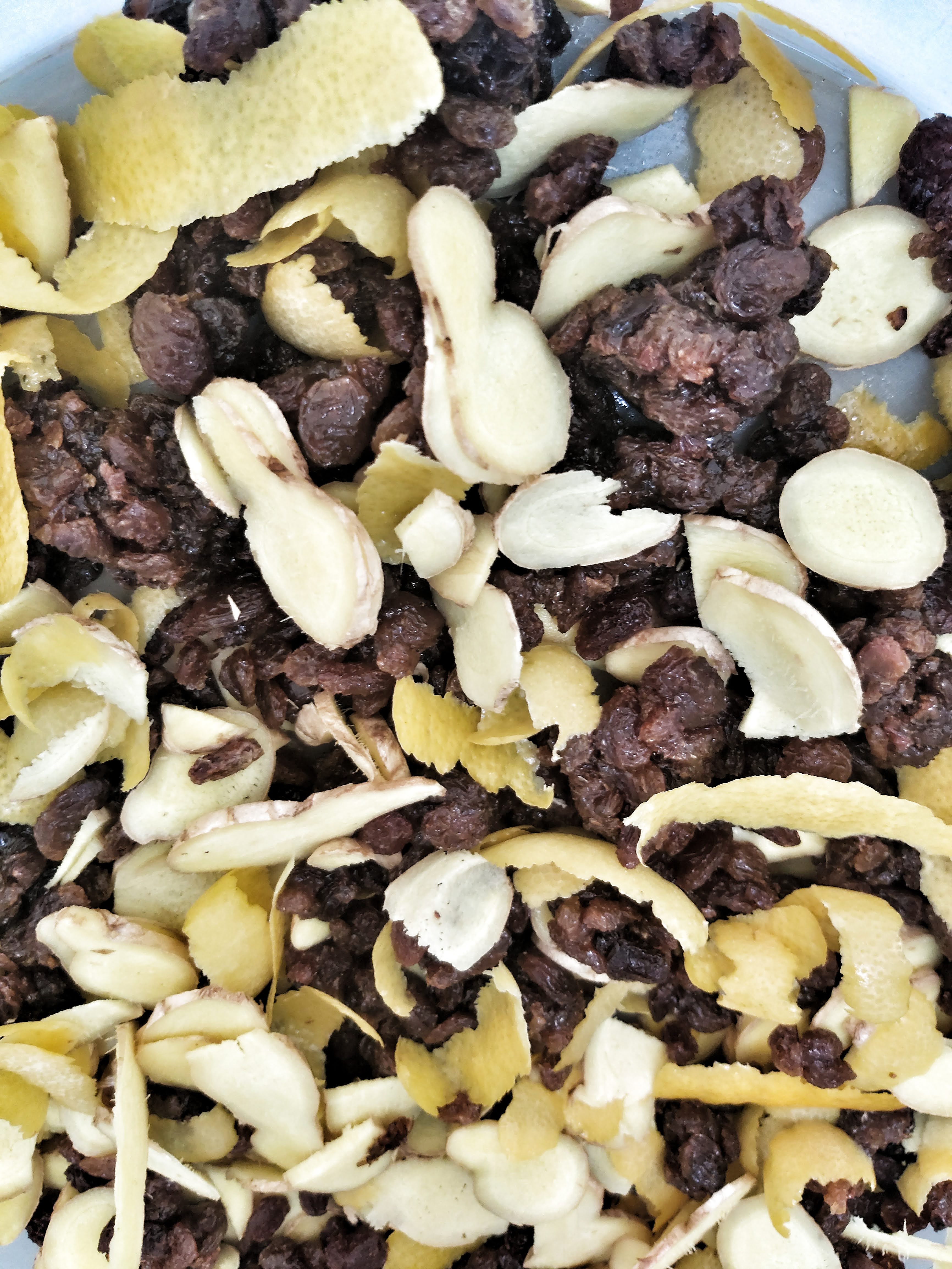
Meanwhile, I sliced 2 oz of ginger thinly and put this, the juice of one lemon, 2 lbs 12 oz sugar, 8 oz minced sultanas and 2 pints of cold water into my bucket. Adding sultanas is new - and has been done to give the wine additional body. I put in six or seven shards of clove - some bits looked like really tny cloves - and this is certainly less clove than I have used on past occasions. I also added less than half a teaspooon each of ground cinnamon and mixed allspice. When the beetroot had finished boiling I poured in the water and discarded the vegetable.

Monday morning I added a teaspoon of nutrient and pectolase. I started a teaspoon of yeast in half a pint of sugary lukewarm water and once that was going put that in too.

Fermenting Beetroot Wine

After stirring once a day, I put the wine into its demijohn on Friday, 9th April whilst listening to the extensive coverage of Prince Philip's death. It was a quick job (the wine, not the death) (though that might have been too) and the wine is a pleasing colour. I have wrapped the demijohn in newspaper, however, so that the colour does not deteriorate (which apparently happens with beetroot wine).

A pleasing colour
(NB - I haven't altered the wine colour, just 
removed the green grass from the photo)


Thursday, 18 March 2021

Orange Wine 2021 - The Making Of...

One of the 'First World Problems' caused by Covid 19 is the sheer amount of queuing that it creates. Whilst one might point to the 120,000 deaths in the UK, the mental health crisis, the vast unemployment and the failure to see loved ones, it was the time spent standing in lines that annoyed me most on Saturday, 6th March. The greengrocer, the butcher and the post office all had long, slow-moving queues and by the time that I got home Claire had to calm me down with cake.

A crate of 24 oranges

Making things better, though, the greengrocer had set aside a box of 24 oranges for me - large Spanish oranges looking like they had been plucked from their tree mere hours ago. 

I started making my wine that afternoon by thinly peeling half of the oranges and covering the peel in two pints of boiling water. This is always the most tedious bit of making orange wine and this year I separated it out of the process by making it my first task, leaving the orange peel to percolate in its water for 24 hours. I did a particularly poor job of avoiding the pith and if this wine turns out too bitter, that will be the explanation. 

A particularly poor job of avoiding the pith

On Sunday afternoon, 7th March, I squeezed all 24 oranges - changing hands every three oranges so as to avoid a painful and overused shoulder. This is a sticky job and required frequent handwashing.

Some of the oranges with outer skin removed

With the oranges being larger than most years I got far more juice - 6 pints (including all the bits of flesh). I added 6¾ pints of cold water and the two pints of water that had been covering the peel. Into this I poured 5½ lbs of sugar and gave it a good stir. I then started 2 teaspoons of yeast fermenting in half a pint of water with a teaspoon of sugar and put this into the mix once fermentation had begun. I added a teaspoon of pectolase and 1½ teaspoons of nutrient. Though my usual timetable would have me putting the wine into its demijohn on Friday, it was Book Group that night (Grownups by Marian Keyes - hated by some, loved by others) so I did this all on Saturday 13th March instead. There was little to sieve out so the process was quick. I am left with two demijohns of pure sunshine.

Two demijohns of sunshine


Thursday, 18 February 2021

Prune & Parsnip Wine 2021 - The Making Of...

Saturday 6th February was a dismal day. I woke to heavy rain and it did not let up throughout the lighted hours. When Claire suggested that I drive to collect the week's groceries rather than walk to Chapel Allerton, I took little persuading. Whilst I prefer to buy my parsnips from the independent Fruit Stall, carrying home 4 lbs of them together with my other shopping in a downpour would have been entirely miserable, so I drove to Sainsbury's instead.

Prunes and Parsnips

I left the wine-making until Sunday, 7th February, which was a much more productive and happy day. I managed to have a 5 mile walk, do a modicum of bassoon practice, make a 'Fly Leg' cake (no flies were harmed in the process) and make my Prune & Parsnip wine. The wine making was done whilst listening to the whole of Hansel and Gretel on Radio 3 - such a fabulous opera, and I know nothing else by Humperdinck.

Parsnips, sliced and in the pan of water

Anyway, to make the wine I sliced 4 lbs of parsnips into small bits and put them into 16 pints of cold water, bringing this up to the boil and then simmering for 20 minutes. (This was done in two lots.) Meanwhile, I snipped up 1 lb of prunes, each prune into 4 or so pieces, and put these in my bucket along with 5 lbs 8 oz sugar. When the parsnips had boiled their 20 minutes, I poured the water into the bucket through a colander and threw out the vegetables.

An enthusiastic fermentation

On Monday morning I added a teaspoon of pectolase, a teaspoon and a half of nutrient and two teaspoons of yeast (though I started the yeast first in a jug with a bit of sweetened water, because I am suspicious of this yeast brand). The wine fermented enthusiastically in its bucket until Saturday morning, 13th February, at which point I put it into its two demijohns, this time listening to Stravinsky's Pulcinella Suite. The wine is far lighter, far more golden, than it has ever been before.

The wine in its demijohns


Thursday, 21 January 2021

Ginger Wine 2021 - The Making Of...

Saturday 9th January began as one of those bitterly cold sunlit days which is the best sort of winter day. Friday's snow had turned from damp and malleable to hard, crunchy and entirely satisfying to walk over. Claire's gender non-specific snowperson was still standing and no-one had stolen its hat. There were a fox's footsteps leading down our drive and everything in the neighbourhood looked different. We get snow so rarely, far less than I remember from my childhood, that I become giddy when it is here.

Ingredients in the snow (plus a bird's footprints)

The walk to Chapel Allerton to buy ingredients for ginger wine was a pleasure, particularly my route through the park watching children hurtling down the hill on their sleds, colourful against the white.

Ginger

I had intended to start this wine on the Saturday but the day ran away from me, so winemaking was a task for Sunday instead. I weighed 6½ oz ginger and, having read an article in The Guardian saying that removing skin from ginger was unnecessary, I gave it a quick scrub instead, sliced it thinly - skin and all - and put this in my bucket. Next I took four lemons and sliced the outermost peel from them, avoiding the pith, and put this in the bucket along with all their juice (11 fluid ounces). I then minced 1 lb of sultanas with the food processor and this went in too. My final winemaking task for the day was to boil 3½ pints of water and pour this over everything.

Lemons and peel

On Monday lunchtime, a day where the snow has vanished entirely, I boiled another 3½ pints of water and put this into the bucket with 2 lbs 8 oz of sugar. I let this cool for five hours and then added a teaspoon each of yeast, nutrient and pectolase.

The dry ingredients (except for sugar)

It took well over 24 hours before I was convinced that the yeast was doing its thing, but eventually it clearly was. I left the wine until Saturday 16th January before putting it into the demijohn - and there it is bubbling away: opaque and dark yellow.

Ginger wine in its demijohn


Sunday, 3 January 2021

Xmas Tutti Fruti 2020 - The Making Of...

Christmas this year, in The Year of The Pestilence, has been different around the country. Those in southern England must celebrate alone. In the north, we were allowed to mix with one other household, but only for the day. Claire and I stayed put - our first Christmas in only each other's company since around 2006. And we had a lovely time. Being married to one's best friend is such a gift, and in this year of enforced isolation has been vital.

We spent much of the day on a 12 mile walk, which I had said would be nine, and watching The Crown (now that I have finally relented and subscribed to Netflix). The first thing I did, though, on Christmas Day, was to empty the freezer of fruit, weigh it and put it into the bucket to defrost.

Much of the fruit

In the order in which this came from the freezer, this wine has:

  • 1 lb 10 oz blackberries
  • 6 oz yellow raspberries
  • 2 lbs 9 oz gooseberries
  • 2 oz blackcurrants
  • 1½ oz rosepetals
  • 1 lb 2½ oz elderberries
  • 4 oz red raspberries
  • 1 lb 9½ oz damsons
  • 3 oz red gooseberries
  • 1 lb ½ oz sloes
  • One clementine (2 oz) (which should have been a satsuma or a tangerine, but never mind)
That all comes to 9 lbs 2 oz of fruit - more than plenty for a double batch.

After attacking the fruit with a potato masher

It defrosted until Boxing Day morn, at which point I attacked the fruit with a potato masher and poured over 12 pints of boiling water. The wine received 5 lbs 11 oz sugar in time, but I only had 3 lbs of sugar at that point in the house, which went in and was stirred until it dissolved.

The discarded fruit

I added two teaspoons of yeast (a new variety - and I checked it was working before adding it), two of nutrient and one of pectolase together with the additional sugar on 27th December. By New Year's Eve, where in normal years we would be in Cambridge, this was ready to go into its demijohn. This was a slow process enlivened by a You're Dead to Me podcast about vampires in Romantic Victorian Literature, and it was clear that I could have used two pints less water in the recipe. The wine is an alarming and wonderful burgundy-with-a-splash-of-purple colour, but it looks like the sediment will be huge.

Two demijohns of alarmingly coloured wine


Thursday, 22 October 2020

Crab Apple Wine 2020 - The Making Of...

The thing that I have missed most from living at Carr Manor Mount, and possibly the only thing, is the crabapple tree. We planted it in 1999 and every year it produced tens of pounds of crab apples. My previous volumes of this diary show how much wine I was able to produce from it, and we still have a couple of bottles remaining from its final batch in 2015.

Large clumps of tiny apples

To recompense, we planted a new crabapple in 2017. The last two years have produced a disappointing haul. 2020, though, has been amazing. For such a small tree the crop is huge: tightly bunched tiny red apples in large clusters. It is as if the tree is covered in scarlet jewels, and it was almost a shame to harvest them.

I did this on Friday 9th October - my first day of Holiday, where we are going neither to the Netherlands nor to Norfolk because of Covid 19. Picking 4 lbs 3 oz of the reddest apples has still left a decent crop on the tree and I could probably have picked the same again. But it is a new variety of crab apple (I forget which) so safest to stick with a single batch this year.

Harvested crab apples

I washed the apples (drowning a spider in the process, which I regret) and whizzed them through the food processor. These went into my bucket, along with 1 lb of minced sultanas (again using the food processor) and 3 lbs sugar. I boiled 7 pints of water and poured this in, giving everything a good stir. On Saturday morning I added a teaspoon each of yeast, nutrient and pectolase.


Sliced apples

I had meant to put the wine into its demijohn on both Wednesday and Thursday, but both days I came back late from a long walk, so I did this Friday morning, 16th October instead. It being later than usual I thought that the ferment would be less vigorous, so filled the demijohn and was a little alarmed at how much sediment it looked like there would be. About half an hour later I was mopping that sediment off the kitchen surfaces and floor. The fermentation had been no less vigorous and the wine had exploded through the air trap.

Bubbling over

I poured some wine out of the demijohn and into a sterilised wine bottle, topping the demijohn up when it was safe to do so (about 24 hours later). Still, it means that I have more wine and less sediment than I might otherwise have had.

Safely in the demijohn

If you want to see how this wine turned out, click here.

Sunday, 4 October 2020

Japonica Quince Wine - The Making Of...

2020, despite its myriad flaws, has been splendid for hard fruit. Our crab apple, pear and apple trees are laden. More unusually, so are all three flowering quinces. In past years they have put out two or three knobbly yellow fruits each. If used at all, these have been turned into jelly but mostly have been ignored. This year, though, each plant has tens of quinces, and that has made my wine-making thumbs twitch. I am not absolutely certain that Japonica Quince wine will work. After all, these are not the edible quinces. Neither, though, are they poisonous and there is only one way to discover whether they are suitable for wine.

Japonica Quinces on their bush

On 27th September I picked 4 lbs 8 oz of quinces, which is probably less than half our potential harvest. This was the bloodiest foraging that I have done: flowering quinces have fierce spikes and my left hand looks like it has done several rounds with an angry cat.

Minor flesh wounds

Back inside, after bathing my wounds, I checked recipes. The one requiring 20 proper quinces was out, leaving the one requiring 3 lemons and the other calling for 1 lb sultanas. I chose the latter on the basis that my previous quince wine was too dry and sultanas should help. Also, this is how I make apple wine.

My haul of quinces

I sliced all the quinces (after washing them) using the food processor and put them in my pan with 7 pints of water. I brought this to the boil and simmered for 15 minutes. Meanwhile I minced 12 oz sultanas (reducing the amount the recipe said, so as to preserve the delicate quince taste) and put these in my bucket with 3 lbs sugar. Once the 15 minutes was up, I poured the water and quinces (and thousands of seeds) into the bucket and stirred until the sugar was dissolved.

The quinces, once sliced

The next morning, Monday, I added a teaspoon each of nutrient, pectolase, citric acid and yeast. On Friday 2nd October I put the wine into its demijohn, which was a lengthy and tedious task. Japonica Quince wine appears to have 'sludge' as its main characteristic, and it was slow to drain through its sieve. Its colour is an attractive peach but there is much foam at the top and I fear it will make an attempt to escape the confines of its glass prison.

Taken the following morning, when the
sediment had sunk.

If you want to see how this wine turned out, click here.

Sunday, 20 September 2020

Elderberry Wine 2020 - The Making Of...

Sunday 6th September, despite being earlier than previous years, was really my only opportunity to forage for elderberries. Next weekend we are in Newcastle (before Leeds is put into quarantine) and the weekend after that would be too late. I had planned to go in the morning, but we were entertaining Jayne in the garden instead. Here I use 'entertaining' to mean 'making polite conversation and enjoying each other's company' rather than juggling fruit and eating fire.

Elderberries that made it into my bag

I drove to my usual parking spot and walked down Kennels Lane, noticing that there was little fruit in the hedgerows on either side. When I got to the field I always use, I discovered that it had been gated: the right of way has been diverted elsewhere. This, though, was not going to stop me! I climbed over the gate and picked the few elderberries there were along the previous right of way. My haul was clearly insufficient, so I wandered along the field side adjoining Kennels Lane, which was far more successful. Every now and again I head a tractor in a nearby field and I kept my eyes open for irate farmers, but my surreptitious plucking remained undetected.

A view across the field 

As usual I came away with two plastic bags three-quarters full, and this translated into 7 lbs of elderberries. It took a very long time to translate them, though - over 2 hours. During this time I listened to many episodes of Punt P.I., learning about Emile Zola's death and a mysterious low hum that certain people hear constantly. Separating elderberries from their stalks is a dull job.

7 lbs of elderberries, successfully stripped

I put 6 lbs of elderberries into my bucket and mashed them with the potato masher. These were covered with 5 lbs 8 oz (which is nearly exactly 2.5 kg) of sugar and 12 pints of boiling water. Next morning I added a teaspoon and a half of nutrient and a teaspoon each of yeast and pectolase.

Putting this into its demijohns was a Friday lunchtime job, so that we could drive to Newcastle in the early evening. I had limited time and was as efficient as possible. Including sterilising my equipment, it took about half an hour. The wine is as dark as ever and is bubbling enthusiastically.

Elderberry wine in its demijohns


Saturday, 5 September 2020

Blackberry Wine 2020 - The Making Of...

What an unusually busy weekend we have just had. Saturday was spent yomping in the North York Moors with Bob & Judith - the first time that we have seen them since January. Then on Sunday, 23rd August, we went to York to pick blackberries and see my parents, whose 56th wedding anniversary it was.

Sarah Moore's grave

We arrived at the cemetery at around 11 and mostly went our separate ways to collect brambles. Claire found a bountiful patch that was sufficiently overgrown to be secluded and which led to a bee hive. I was rather less successful, finding the odd stem laden with fruit here and there, but mostly found whole areas where the blackberries were already rotten or covered in grey mould. 

Claire picking blackberries

During this search I coincided with a man and his pre-teen children: Elliot and Isobel, who were enthusiastic bramble pickers. Isobel had a large tub full of blackberries, reserved for crumble, and they were interested in how I turned blackberries into wine. The father commented that the beauty of the cemetery was that there was enough fruit for everyone. "Yes," I agreed, secretly not agreeing at all and seeing him and his children very much as the competition. We went our separate ways and finally, finally I found an excellent area for foraging - near to, but behind, the chapel. Here the graves were Mary Ann Nightingale and her husband George, Sarah Moore and Jane Oldfield. Earlier I had picked from Harriet Atkinson and Robert Burton. Thomas Douthwaite did not figure this year: his grave had been cleared of brambles.

Near the Chapel

Once back in Leeds I weighed the fruit. I had picked 4 lbs 1 oz and Claire won convincingly with 6 lbs 5oz. I used 8 lbs, putting the rest in the freezer, and mashed them in my bucket. I poured in 5 lbs 12 oz of sugar and 11¼ pints of boiling water (though could have used half a pint less). Next morning I added the yeast (Mangrove Jack's R56), 1½ teaspoons of nutrient and a teaspoon of pectolase.

Blackberries in their bucket

I put the wine into its demijohns on Friday 28th August whilst listening to the first Prom of 2020 - played to an empty Albert Hall. And now I have two demijohns of blackberry wine bubbling away.

Two demijohns of Blackberry Wine

If you want to see how this wine turned out, click here.